Scroll Down

Scroll Down

Dear Visitor, it is our passion to bring the history of science back to life in the imagination of our visitors. Although you can find all information while viewing our sites on a mobile device, we would like to invite you to explore or trip into the history of science on a big screen.

Share the link and visit us when you have the time and space!

“Videos and some images on our website have been generated using artificial intelligence and does not depict a real photograph of the historical people. As part of the Mitmannsgruber “History of Science” project, we use AI technology responsibly to help visualize forgotten chapters of scientific history and make them accessible to modern audiences!”

Elihu Thomson

Elihu Thomson was a prolific inventor and electrical pioneer whose innovations helped shape the modern world. Born in England in 1853, he immigrated to America as a child and became instrumental in the rise of the U.S. electrical industry. Thomson co-founded the Thomson-Houston Electric Company and later joined forces with Thomas Edison to create the General Electric Company, forming one of the world’s leading technology enterprises. Over a five-decade career, he amassed nearly 700 patents on inventions ranging from generators and transformers to lamps and welding machines. Remarkably, Thomson began his career as a schoolteacher in Philadelphia, which imbued him with a lifelong passion for learning and experimentation that fueled his inventive work. Unlike many inventors of his era, Thomson championed scientific research within industry, establishing one of the first corporate research laboratories and earning a reputation as GE’s “scientific sage”. He pioneered advances in arc lighting, alternating-current systems, electric welding, and even early X-ray technology, constantly bridging the gap between scientific discovery and practical application. Cities around the globe were illuminated by Thomson’s arc lamps, and households began measuring electricity usage with his watt-hour meter. He improved X-ray tubes for medicine and introduced methods that influenced everything from urban transit to ship propulsion. At the dawn of the electrical age, Thomson’s genius spanned everything from practical engineering to bold scientific insight, earning him recognition as one of the greatest pioneers of both DC and AC power. He played a pivotal role in the War of the Currents – advocating for alternating current (AC) technology and ultimately helping AC become the dominant standard in America, even as Edison stubbornly promoted direct current. Few inventors could match the scope of Thomson’s impact; indeed, in his time he was often compared to Edison himself for the breadth of his innovations. By the time of his death in 1937, Thomson had earned international acclaim – including top honors like the Edison Medal and Faraday Medal – and cemented his legacy as a driving force of the electrical age. In the exciting journey that follows, we explore how this visionary inventor grew from curious schoolteacher to legendary innovator, leaving an indelible mark on modern life.

March 29, 1853
in Manchester, England
March 13, 1937
in Swampscott, Massachusetts, USA
Areas:Dynamos

Early Life and Sparks of Genius

Elihu Thomson was born to a mill mechanic’s family in Manchester, England, where his childhood fascination with machines began early. His father’s work fixing mill machinery had stirred young Thomson’s interest in how things worked. In 1858, after his father lost his work, the family immigrated to Philadelphia, seeking new opportunities. Thomson quickly excelled in science at Philadelphia’s Central High School, and by the age of 17 he had graduated and become a teacher there. His precocious talent was evident – he even attained the chemistry professorship by his early twenties. Restless curiosity drove the young educator to conduct experiments after school hours. He devoured a popular science book of tricks and inventions and famously built a homemade electrical machine using a glass wine bottle. When he first spun it and drew crackling sparks of static electricity, Thomson was enthralled – and so were his skeptical parents after he playfully gave his father a jolt that changed the old man’s tune. This inventive streak only grew stronger over time.

By the mid-1870s, Thomson had teamed up with a like-minded colleague, Edwin J. Houston, at Central High. Together the two teachers turned a tiny school laboratory into a workshop of electrical innovation. In 1875, Thomson astounded the Franklin Institute in Philadelphia by demonstrating what we now recognize as wireless signal transmission – detecting induced sparks on distant metal objects from an induction coil, thereby anticipating radio waves over a decade before Heinrich Hertz. He also began dabbling in electric lighting: in 1878 Thomson designed and built a small dynamo capable of powering a single arc lamp, wowing audiences with an artificial “sun” of electricity. This prototype arc light – complete with an automatic regulator to keep its current steady – impressed onlookers and hinted at a practical system for illuminating city streets. Thomson’s lectures and demos quickly earned him a reputation as a rising star in the electrical field. Poised to move from classroom to industry, he was laying the sparks of genius that would soon ignite an empire in electric lighting.

Lighting the Way: Arc Lamps and Industry

In 1880, riding the momentum of his arc lamp invention, Thomson and Edwin Houston launched their own venture. With backing from intrigued financiers, they founded the American Electric Company in New Britain, Connecticut, to commercialize arc lighting on a grand scale. Thomson – just 27 years old – held the post of chief electrician and brought boundless ingenuity to the firm. His arc lamp systems, with their clever automatic regulators and robust multi-coil dynamos, proved reliable for street illumination, and soon cities across America were ablaze with artificial daylight. Recognized as a leader in the field (alongside fellow arc-light pioneer Charles F. Brush in Cleveland), Thomson rapidly expanded his company’s reach. In 1882, a group of Massachusetts investors led by industrialist Charles Coffin acquired control of Thomson’s startup and moved it to Lynn, Massachusetts. By 1883 it was rechristened the Thomson-Houston Electric Company, with Thomson’s name proudly on the masthead. From a small factory in Lynn, Thomson and his team churned out dynamos, arc lamps, and electrical equipment, fueling the young nation’s power and light. The brilliant arc lights of Thomson-Houston illuminated streets, theatres, and public squares, eroding the darkness that had once constrained city life.

As the company grew through the mid-1880s, Thomson proved adept at both innovation and competition. In 1886, he boldly entered the incandescent lighting arena by acquiring the Sawyer & Man Electric Company – securing valuable bulb patents and challenging Thomas Edison’s monopoly on the electric light bulb. Thomson-Houston also branched into new territories: developing electrical generators, motors for trolleys, and even early power distribution systems. Meanwhile, Thomson himself never stopped inventing – from improved transformers to experimental high-frequency devices – and patent applications flowed relentlessly from his drafting table. By 1890, Thomson-Houston stood as a formidable rival to Edison’s company as well as George Westinghouse’s enterprise, ranking among the top three electrical firms in America. The stage was set for a showdown in the booming electric industry, with Thomson’s Lynn operation squaring off against Edison’s empire in what journalists dubbed a “War of the Currents.”

Currents of Competition and the Birth of General Electric

By the late 1880s, the rivalry between America’s electric companies reached a fever pitch. Thomas Edison staunchly promoted his direct-current (DC) electrical system, but Thomson and other visionaries were convinced that alternating current (AC) was the future. Thomson’s experiments and advocacy for AC – mirroring work by Nikola Tesla and George Westinghouse – gained traction, especially after he demonstrated that AC power could be regulated and distributed effectively. Edison fought back fiercely (even publicizing stunts to paint AC as dangerous), yet by 1890 the superior economics of high-voltage AC transmission were undeniable. Thomson-Houston’s adoption of AC technology helped tip the scales. The so-called War of the Currents was effectively won: alternating current emerged as the new U.S. standard, lighting cities and powering factories over long distances.

Amid this industry upheaval, an even more dramatic turn of events took place in 1892. Banking titan J. P. Morgan brokered a historic merger between Thomson’s company and its chief rival, the Edison General Electric Company. The result was the birth of the General Electric Company – uniting the best of Edison’s and Thomson’s innovations under one corporate roof. While Edison himself soon stepped away, Elihu Thomson became a guiding technical force in the new organization. At GE’s sprawling factories and offices, Thomson instilled his ethos of constant improvement and scientific research. Colleagues dubbed him a “scientific sage” for his deep knowledge and calm guidance. Under Thomson’s influence, the freshly minted GE poured resources into research and product development, setting up a dedicated industrial laboratory that would push the frontiers of electrical technology. The newly merged company combined Edison’s expertise in incandescent lighting with Thomson’s strengths in power systems, creating an industrial titan poised to electrify the nation. Thomson oversaw the integration from his old Lynn works (now a key GE plant), and within a short time GE dominated America’s electrical industry – from home lighting to large generators. He also mentored the next generation of innovators – Charles Proteus Steinmetz, the brilliant AC theorist, among them – ensuring that GE stayed at the cutting edge of technology. Having won the battles of the past decade, Thomson pushed eagerly forward: before long he was delving into novel frontiers like X-ray apparatus and high-frequency currents, setting the stage for his next great innovations.

Innovation and Invention in the Electric Age

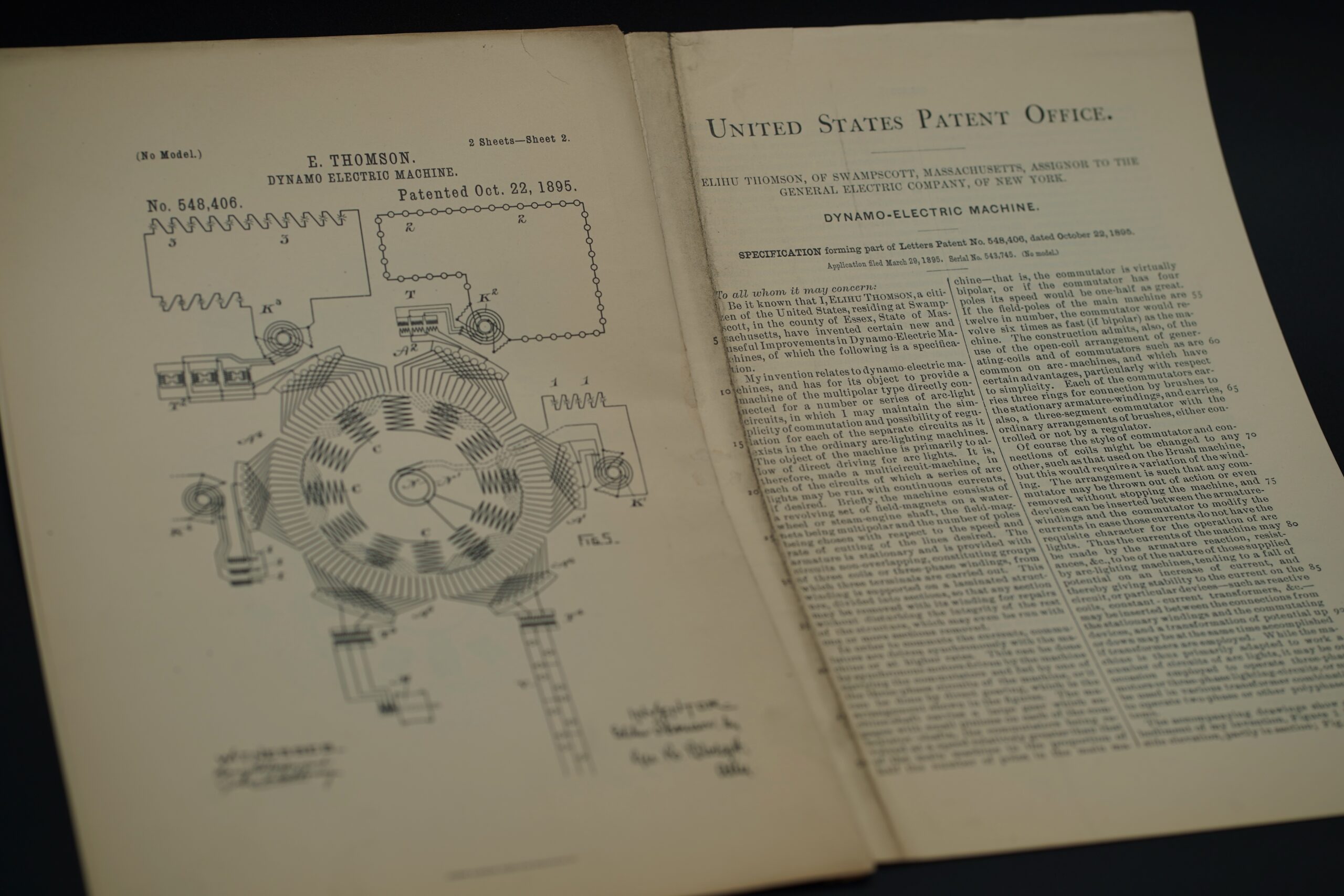
The mid-1890s saw Thomson at the forefront of new scientific marvels. When German physicist Wilhelm Röntgen discovered mysterious X-rays in 1895, Thomson immediately took notice. He devised improved X-ray tubes and apparatus at GE and by early 1896 was capturing ghostly radiographs of hand bones and metal objects lodged inside flesh. Doctors marveled at these early medical X-ray images, made possible by Thomson’s engineering skill. Always the experimenter, he even tried stereoscopic X-ray photographs to add depth to the images. Thomson’s quick work in radiology – mere weeks after X-rays were first reported – demonstrated his knack for translating abstract discoveries into practical devices. Meanwhile, Thomson kept enhancing the electrical machines that drove everyday technology. In October 1895, he secured U.S. Patent 548,406 for a “Dynamo-Electric Machine,” a new generator capable of supplying multiple arc lamp circuits or even polyphase AC power from one unit. This multipurpose dynamo gave lighting systems greater flexibility and efficiency. Thomson also contributed to perfecting the transformer and in 1898 introduced a pioneering “watt-hour meter” to measure electricity consumption – a device that utilities worldwide soon adopted.

Nor did Thomson’s inventiveness stop there. He had long been exploring electrical metallurgy, and in 1886 he patented one of the first processes for electric welding. After noticing that a strong spark could fuse metal wires together, Thomson built the first practical resistance welding machine, using heavy currents and clamps to join metals. His technique proved versatile – it could weld anything from delicate lamp filaments to hefty steel pipes – and it laid the groundwork for modern industrial welding. By the turn of the century, Thomson’s name was attached to hundreds of inventions spanning motors, generators, lighting, transportation, and communication. He became one of the world’s most prolific inventors, second only to Edison in U.S. patents, and many of his creations from this period remain fundamental to our electric infrastructure today. With each breakthrough – from illuminating city streets to peering inside the human body with X-rays – Thomson solidified his reputation as the consummate inventor-engineer of the electric age.

Original 1895 patent drawing and specification of Elihu Thomson’s Dynamo-Electric Machine, U.S. Patent 548,406, photographed for Mitmannsgruber historical collection.
Authentic patent document from October 22, 1895: Elihu Thomson’s groundbreaking Dynamo-Electric Machine (U.S. Patent No. 548,406) – a pivotal invention that shaped the future of industrial electricity.

Legacy and Lasting Impact

By the time Elihu Thomson reached his later years, he was internationally acclaimed as an elder statesman of science and technology. He received virtually every honor his field could bestow: the Franklin Institute’s Elliott Cresson Medal, the prestigious Edison Medal, Faraday Medal, and many others. Leading universities such as Harvard and Yale granted him honorary doctorates in recognition of his achievements. In 1920, Thomson even stepped in as acting president of MIT, nurturing young engineers at the very kind of institution he had once lacked. Though he had helped found one of the world’s largest companies, Thomson remained at heart a scholar and inventor first. He stayed active in research well into his seventies and was revered for his humility, generosity, and encyclopedic knowledge. When Thomson passed away in 1937 at his home in Massachusetts, tributes poured in from around the globe for the man whose life spanned – and shaped – the electric revolution.

Thomson’s legacy is literally wired into the modern world. The electrical grid that powers our cities, the household appliances and lights we take for granted, the electric trains and subways, the X-ray machines in hospitals, even the industrial welding techniques that fuse our skyscrapers – all trace a part of their lineage to Thomson’s inventive genius. He not only gave us specific inventions like the arc lamp and the watt-hour meter, but also pioneered the concept of industrial research that drives innovation to this day. His influence on peers and protégés was profound; innovators like Steinmetz carried his torch forward, and companies across the globe emulated the in-house research culture he championed. Today, Thomson’s nearly 700 patents and papers stand as a testament to a lifetime of creation. Collectors and historians prize his original patent documents – such as his 1895 dynamo patent – as treasures of scientific history, tangible reminders of the era one brilliant mind helped create. In the annals of innovation, Elihu Thomson shines as the electric age’s master builder, a tireless innovator who transformed the sparks of his imagination into the power and light of our modern life.